Примечание
Перейти в конец, чтобы скачать полный код примера или запустить этот пример в браузере с помощью JupyterLite или Binder.
Извлечение тем с помощью неотрицательной матричной факторизации и латентного размещения Дирихле
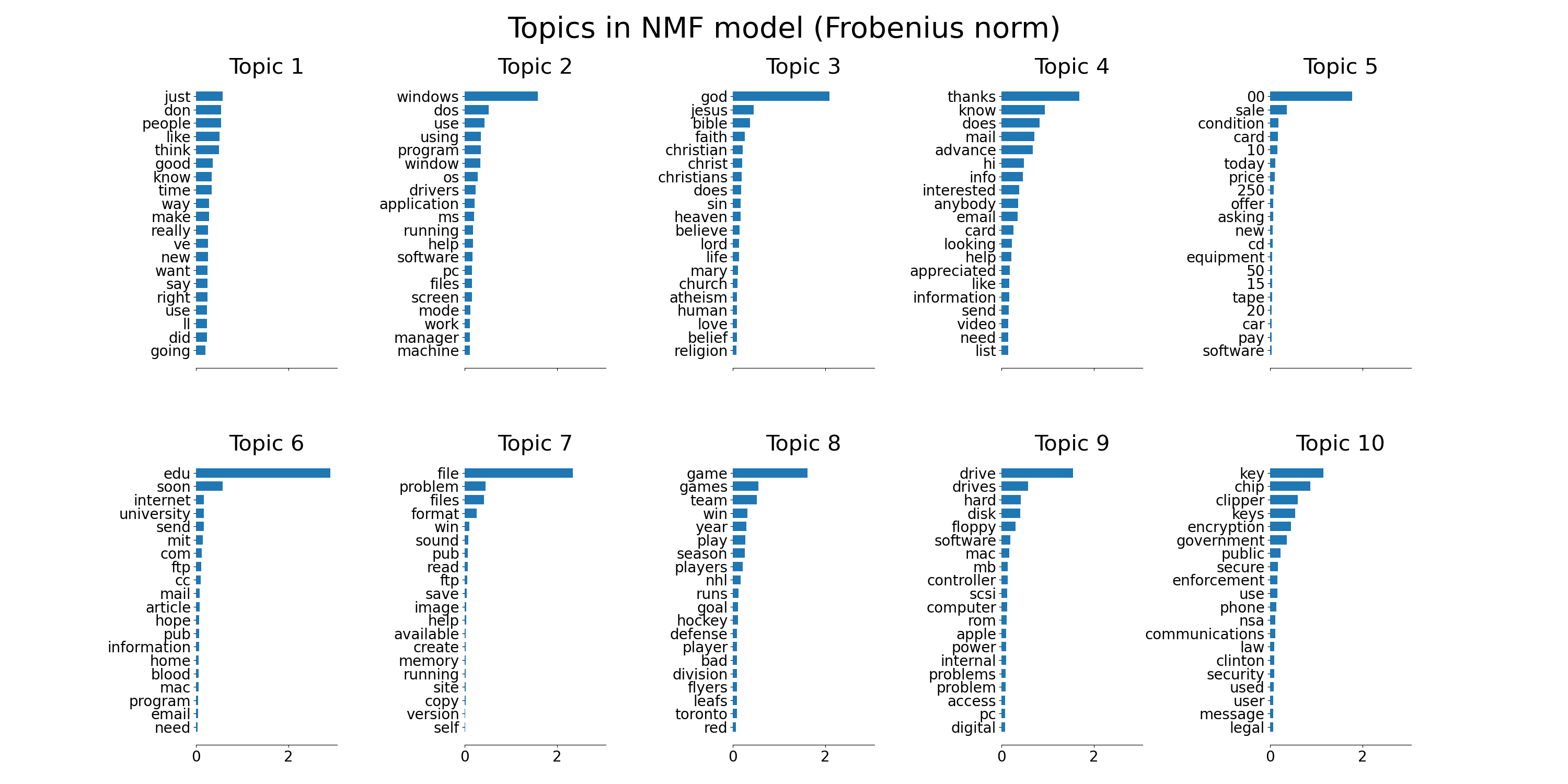
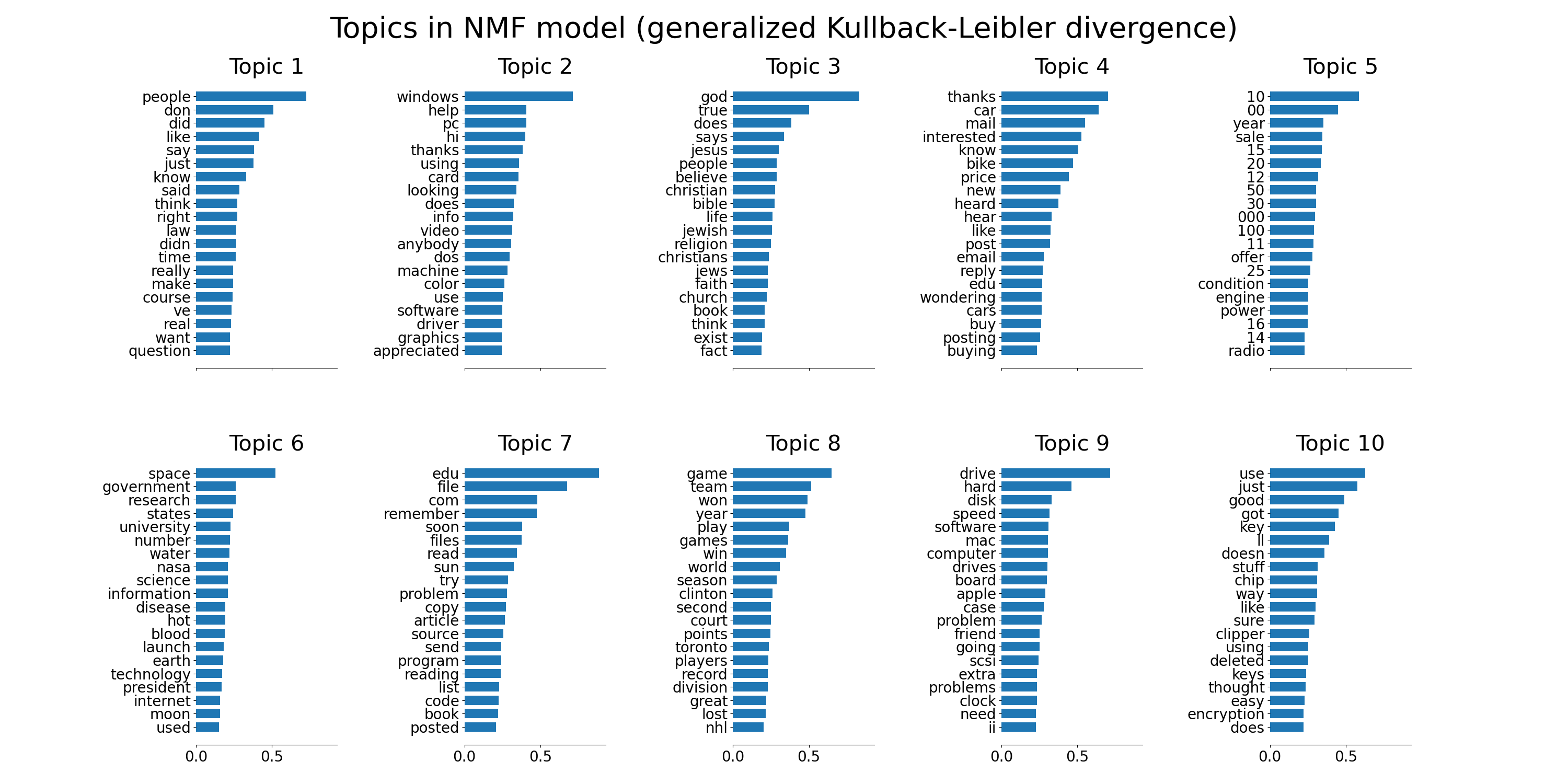
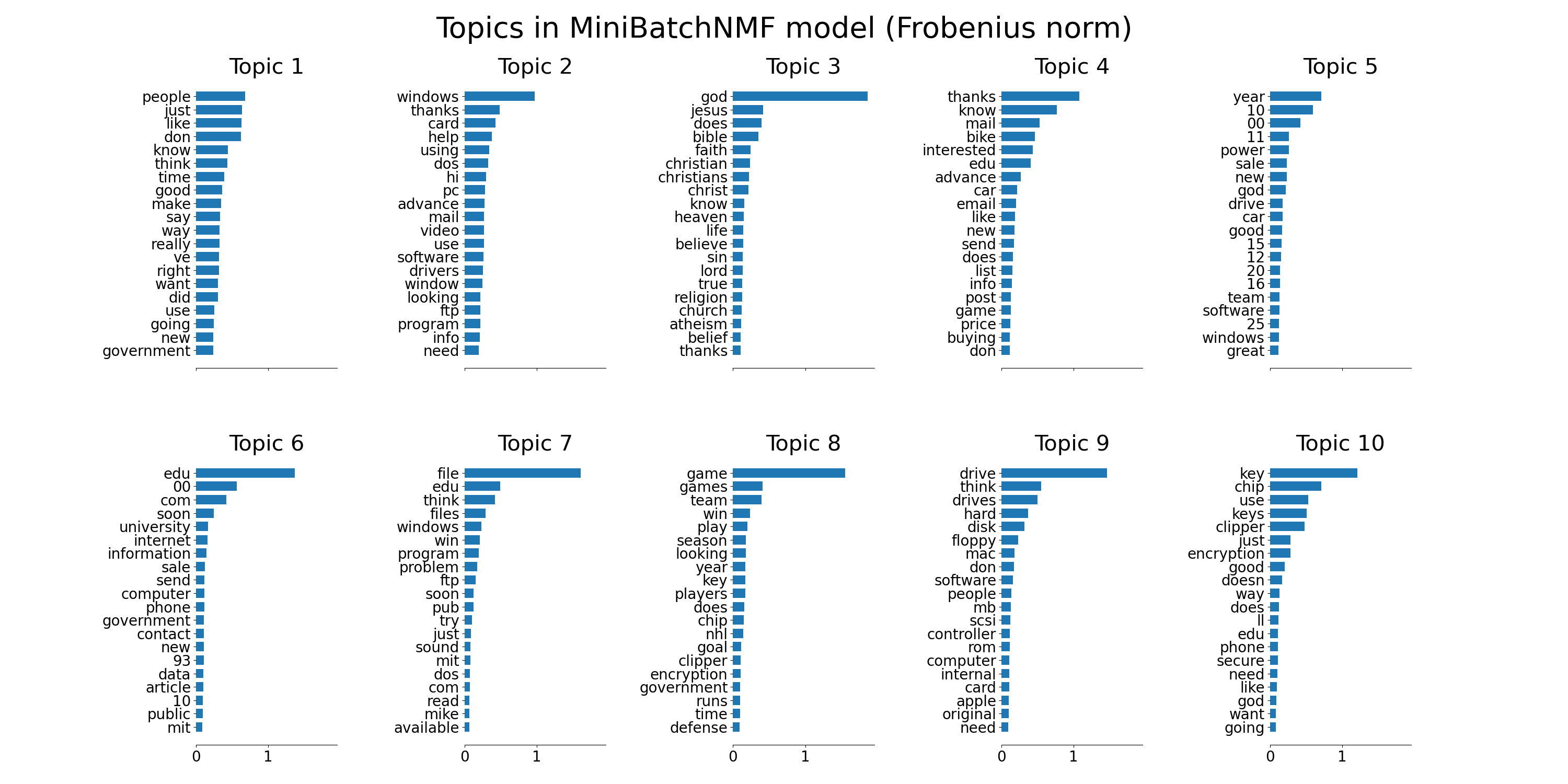
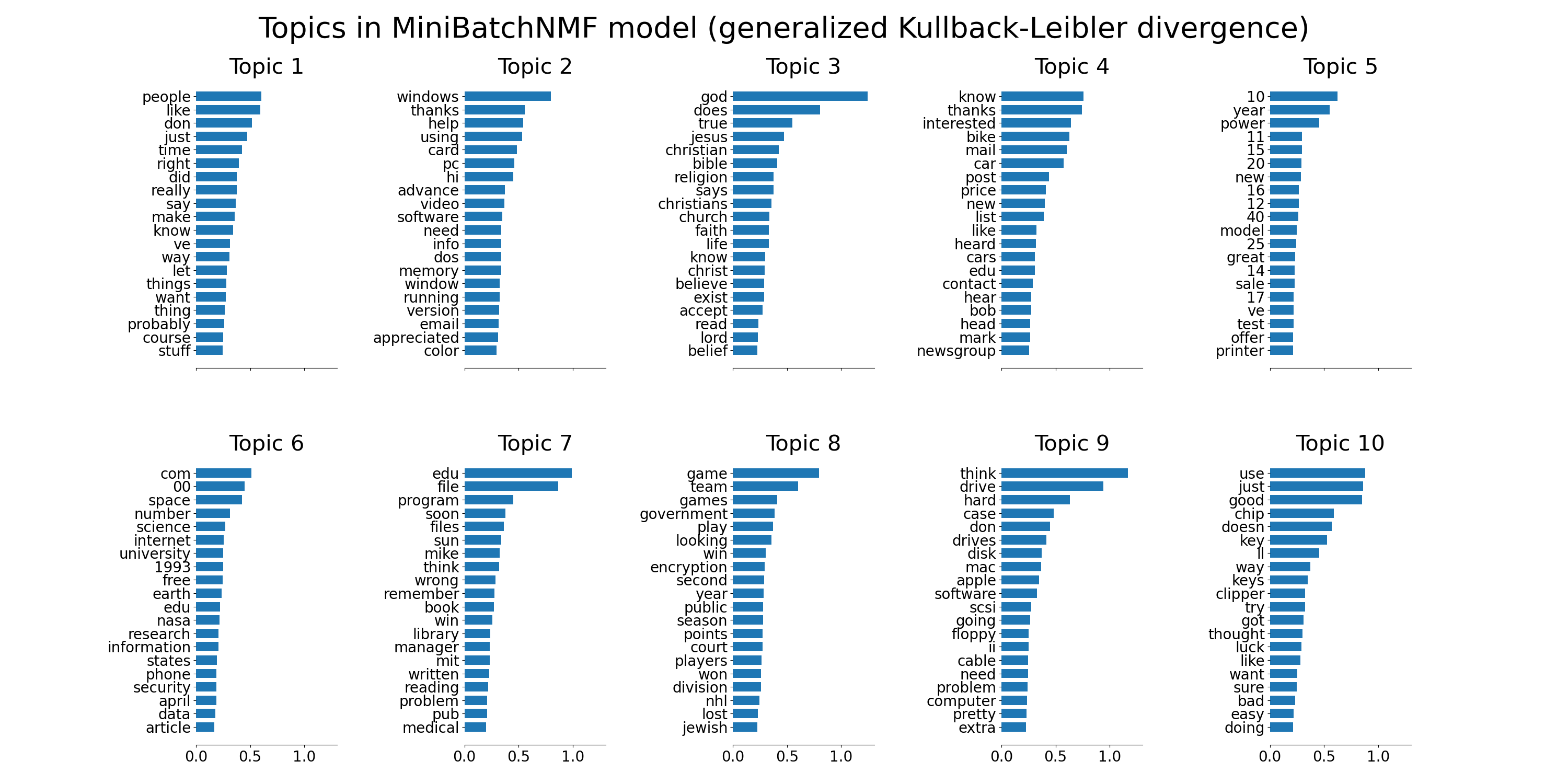
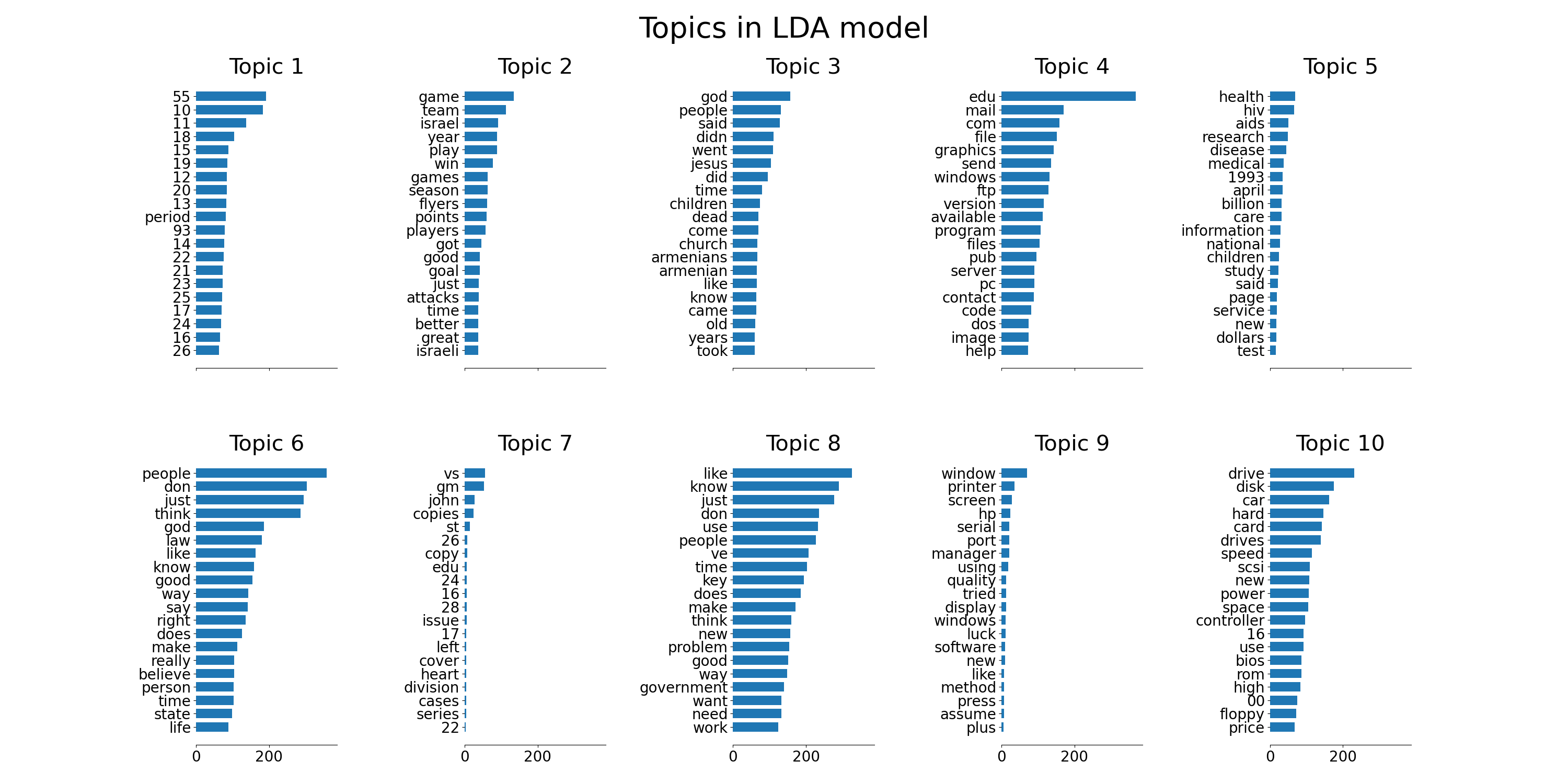
В этом примере показано применение NMF и LatentDirichletAllocation к корпусу документов для извлечения аддитивных моделей структуры тем корпуса. Результат представлен в виде графика тем, каждая из которых отображается столбчатой диаграммой с несколькими наиболее значимыми словами, выбранными на основе весов.
Неотрицательная матричная факторизация применяется с двумя различными целевыми функциями: нормой Фробениуса и обобщённой дивергенцией Кульбака — Лейблера. Последняя эквивалентна вероятностному латентно-семантическому индексированию.
Параметры по умолчанию (n_samples / n_features / n_components) должны позволить запустить пример за несколько десятков секунд. Можно увеличить размерность задачи, но помните, что временная сложность NMF полиномиальна. В LDA временная сложность пропорциональна (n_samples * iterations).
Loading dataset...
done in 1.344s.
Extracting tf-idf features for NMF...
done in 0.335s.
Extracting tf features for LDA...
done in 0.308s.

Fitting the NMF model (Frobenius norm) with tf-idf features, n_samples=2000 and n_features=1000...
done in 0.079s.


 Fitting the NMF model (generalized Kullback-Leibler divergence) with tf-idf features, n_samples=2000 and n_features=1000...
done in 1.587s.


 Fitting the MiniBatchNMF model (Frobenius norm) with tf-idf features, n_samples=2000 and n_features=1000, batch_size=128...
done in 0.091s.


 Fitting the MiniBatchNMF model (generalized Kullback-Leibler divergence) with tf-idf features, n_samples=2000 and n_features=1000, batch_size=128...
done in 0.253s.


 Fitting LDA models with tf features, n_samples=2000 and n_features=1000...
done in 2.836s.
# Authors: The scikit-learn developers
# SPDX-License-Identifier: BSD-3-Clause

from time import time

import matplotlib.pyplot as plt

from sklearn.datasets import fetch_20newsgroups
from sklearn.decomposition import NMF, LatentDirichletAllocation, MiniBatchNMF
from sklearn.feature_extraction.text import CountVectorizer, TfidfVectorizer

n_samples = 2000
n_features = 1000
n_components = 10
n_top_words = 20
batch_size = 128
init = "nndsvda"


def plot_top_words(model, feature_names, n_top_words, title):
    fig, axes = plt.subplots(2, 5, figsize=(30, 15), sharex=True)
    axes = axes.flatten()
    for topic_idx, topic in enumerate(model.components_):
        top_features_ind = topic.argsort()[-n_top_words:]
        top_features = feature_names[top_features_ind]
        weights = topic[top_features_ind]

        ax = axes[topic_idx]
        ax.barh(top_features, weights, height=0.7)
        ax.set_title(f"Topic {topic_idx + 1}", fontdict={"fontsize": 30})
        ax.tick_params(axis="both", which="major", labelsize=20)
        for i in "top right left".split():
            ax.spines[i].set_visible(False)
        fig.suptitle(title, fontsize=40)

    plt.subplots_adjust(top=0.90, bottom=0.05, wspace=0.90, hspace=0.3)
    plt.show()


# Load the 20 newsgroups dataset and vectorize it. We use a few heuristics
# to filter out useless terms early on: the posts are stripped of headers,
# footers and quoted replies, and common English words, words occurring in
# only one document or in at least 95% of the documents are removed.

print("Loading dataset...")
t0 = time()
data, _ = fetch_20newsgroups(
    shuffle=True,
    random_state=1,
    remove=("headers", "footers", "quotes"),
    return_X_y=True,
)
data_samples = data[:n_samples]
print("done in %0.3fs." % (time() - t0))

# Use tf-idf features for NMF.
print("Extracting tf-idf features for NMF...")
tfidf_vectorizer = TfidfVectorizer(
    max_df=0.95, min_df=2, max_features=n_features, stop_words="english"
)
t0 = time()
tfidf = tfidf_vectorizer.fit_transform(data_samples)
print("done in %0.3fs." % (time() - t0))

# Use tf (raw term count) features for LDA.
print("Extracting tf features for LDA...")
tf_vectorizer = CountVectorizer(
    max_df=0.95, min_df=2, max_features=n_features, stop_words="english"
)
t0 = time()
tf = tf_vectorizer.fit_transform(data_samples)
print("done in %0.3fs." % (time() - t0))
print()

# Fit the NMF model
print(
    "Fitting the NMF model (Frobenius norm) with tf-idf features, "
    "n_samples=%d and n_features=%d..." % (n_samples, n_features)
)
t0 = time()
nmf = NMF(
    n_components=n_components,
    random_state=1,
    init=init,
    beta_loss="frobenius",
    alpha_W=0.00005,
    alpha_H=0.00005,
    l1_ratio=1,
).fit(tfidf)
print("done in %0.3fs." % (time() - t0))


tfidf_feature_names = tfidf_vectorizer.get_feature_names_out()
plot_top_words(
    nmf, tfidf_feature_names, n_top_words, "Topics in NMF model (Frobenius norm)"
)

# Fit the NMF model
print(
    "\n" * 2,
    "Fitting the NMF model (generalized Kullback-Leibler "
    "divergence) with tf-idf features, n_samples=%d and n_features=%d..."
    % (n_samples, n_features),
)
t0 = time()
nmf = NMF(
    n_components=n_components,
    random_state=1,
    init=init,
    beta_loss="kullback-leibler",
    solver="mu",
    max_iter=1000,
    alpha_W=0.00005,
    alpha_H=0.00005,
    l1_ratio=0.5,
).fit(tfidf)
print("done in %0.3fs." % (time() - t0))

tfidf_feature_names = tfidf_vectorizer.get_feature_names_out()
plot_top_words(
    nmf,
    tfidf_feature_names,
    n_top_words,
    "Topics in NMF model (generalized Kullback-Leibler divergence)",
)

# Fit the MiniBatchNMF model
print(
    "\n" * 2,
    "Fitting the MiniBatchNMF model (Frobenius norm) with tf-idf "
    "features, n_samples=%d and n_features=%d, batch_size=%d..."
    % (n_samples, n_features, batch_size),
)
t0 = time()
mbnmf = MiniBatchNMF(
    n_components=n_components,
    random_state=1,
    batch_size=batch_size,
    init=init,
    beta_loss="frobenius",
    alpha_W=0.00005,
    alpha_H=0.00005,
    l1_ratio=0.5,
).fit(tfidf)
print("done in %0.3fs." % (time() - t0))


tfidf_feature_names = tfidf_vectorizer.get_feature_names_out()
plot_top_words(
    mbnmf,
    tfidf_feature_names,
    n_top_words,
    "Topics in MiniBatchNMF model (Frobenius norm)",
)

# Fit the MiniBatchNMF model
print(
    "\n" * 2,
    "Fitting the MiniBatchNMF model (generalized Kullback-Leibler "
    "divergence) with tf-idf features, n_samples=%d and n_features=%d, "
    "batch_size=%d..." % (n_samples, n_features, batch_size),
)
t0 = time()
mbnmf = MiniBatchNMF(
    n_components=n_components,
    random_state=1,
    batch_size=batch_size,
    init=init,
    beta_loss="kullback-leibler",
    alpha_W=0.00005,
    alpha_H=0.00005,
    l1_ratio=0.5,
).fit(tfidf)
print("done in %0.3fs." % (time() - t0))

tfidf_feature_names = tfidf_vectorizer.get_feature_names_out()
plot_top_words(
    mbnmf,
    tfidf_feature_names,
    n_top_words,
    "Topics in MiniBatchNMF model (generalized Kullback-Leibler divergence)",
)

print(
    "\n" * 2,
    "Fitting LDA models with tf features, n_samples=%d and n_features=%d..."
    % (n_samples, n_features),
)
lda = LatentDirichletAllocation(
    n_components=n_components,
    max_iter=5,
    learning_method="online",
    learning_offset=50.0,
    random_state=0,
)
t0 = time()
lda.fit(tf)
print("done in %0.3fs." % (time() - t0))

tf_feature_names = tf_vectorizer.get_feature_names_out()
plot_top_words(lda, tf_feature_names, n_top_words, "Topics in LDA model")
Общее время выполнения скрипта: (0 минут 11.877 секунд)


Связанные примеры


© 2007–2026 The scikit-learn developers
Licensed under the 3-clause BSD License.
https://scikit-learn.org/1.9/auto_examples/applications/plot_topics_extraction_with_nmf_lda.html


